InstaSnap: Making Your Brand Sociable

Back in the day building a brand meant having a nicely-designed logo, planned advertising/media campaigns and perhaps even a brand style guide. Well, those days are toast. Today, it’s important that at least part of your brand strategy includes the question: “Is this something someone well Snap?”

When I first started dabbling in social media within the automotive industry nearly 10 years ago, the goal for brand leaders was to get social “ambassadors” to post blog posts or tweets about the brand. These semi-organic endorsements ultimately served as positive reinforcements to each ambassador’s social reach; new-school word-of-mouth.

We’ve evolved since then. Now there’s SnapChat, Instagram stories, Facebook stories and probably a few other mediums I’m not even aware of yet. Now let’s throw in that, since 2015, highly-sociable Millennials have been the largest consumer by generation. These folks (such as myself) value experiences, and love to brag about said experiences on social media channels, of which they’ve grown up with.

So, with the convergence of new social channels and new consumer behavior from a new generation, the brand calculus must change. As marketers, we must convert some of our customer touch-points into social-points; opportunities for organic brand reach through genuine initiatives.

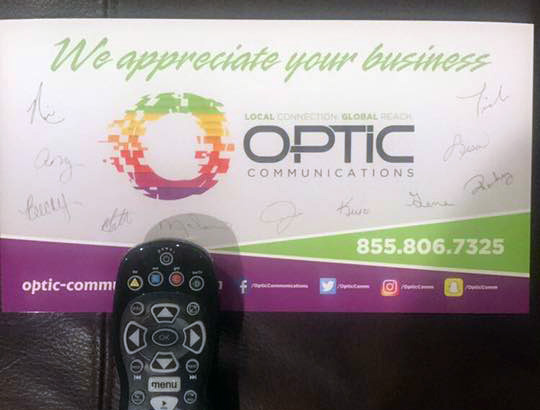
At Optic, we’ve been taking a conscious look at all of our touch-points with the goal of converting some of them into social-points. An example is actually a fairly old-school method: a piece of print collateral.

Since the vast majority of our customers are new to the brand, we’ve implemented a new ‘welcome card’ with the brand prominently displayed and the signature of every employee on the cover as a thank you to the customer. We also reinforce to the customer they at the conclusion of their installation, they have one of the most advanced fiber-optic networks in the country at their home.

Installers are trained to place the card near the customer’s primary TV and place their new remote (if a cable subscriber) on the card. As you can see from the above photo pulled from a customer’s Facebook profile: the card has been used as-intended (several times!).

The takeaway here is to remember that we, as marketers, cannot get hung-up on digital and other “shiny objects” in our field. There is still a place for old school collateral in the digital world, but be smart about it and tailor it to blend into the social-points.

Another initiative we’ve taken is more cutting-edge. We’ve been experimenting with SnapChat geo-filters. Specifically, we ran one at a county fair earlier this summer that was more regionally themed; our brand took a backseat. Over a four-day period the filter was used 1,300 times and seen by 35,700 pairs of eyes. Note that the impression count is larger than the number of residents in the county.

Lastly, product development must have a eye to social-points as well. We’re in the process of rolling out Amazon Alexa support on our flagship video product. This feature will, unquestionably, end up on the SnapChat stories of some of our customers. And yes, we’re developing a few 10-second videos to aid in the bragging effort.

While focusing on what I’m calling social-points of the customer experience are becoming an important tool for marketers, it’s worth noting these are not replacing the fundamentals. Part of enabling social-points as sharable content by your consumers means having an aspirational brand. If your brand and product (or service) is not aspirational (even premium); social-points will go, well, unshared.

Remember the four P’s of marketing; Price, Production, Place and Promotion? Yeah, you still have to get those right first.




Brand Building Without The Brand

snapchat1

Optic’s SnapChat filter.

Here’s the challenge: build a brand in an era of total brand clutter and advertising noise. It’s a tall task in the current market environment, but it is mine in my day job. Success or failure of that task lies almost entirely at my feet, because I’m given a free reign and budget to try just about anything. Trying anything and sometimes stretching the limits of superiors’ tolerances has become the name of the game of brand building for me. However, some of the most effective measures have occurred when the focus is on anything but the very brand I’m tasked with building.

Discreet branding is a thing. I recall reading about it in MBA classes and more recently in HBR. Most of the case studies on it are from very large firms with significant brand equity already in the bag, so when I attempted it with our new, local brand it was purely experimental. So, my tactics.

In recent weeks nearly all of my middle-aged co-workers have hoped on the SnapChat train. We had a little SnapChat 101 in the office one day, which included everyone using the app to sweep their contacts to see what other adults were on there. Scandalous. At any rate, I had already got the company on SnapChat and like a proper Millennial, I’ve been using it personally for awhile for some good and bad stuff [don’t ask my friends about the sleeping pill incident].

Nonetheless, our local county fair was a few weeks ago. Given that everyone from my own Mother on down is using SnapChat on a daily basis, I thought, “What if we put a fair-themed filter on there for the week?”

Fast-forward six hours and our creative agency had already designed a geo-filter and I already had it purchased. The theme was regional and our logo was fairly discreetly placed in the bottom of the filter. It was geo-fenced to the fair grounds because I quickly found that geo-fencing the whole town was probably going to max my company credit card.

My expectations for this little endeavor were fairly low. To my knowledge no local/regional company had ever used this medium, so I was lab-ratting this with Optic. Then the first night of the fair I saw tweets from people way younger than myself…about our filter!

Then I started hearing from employees that their kids or their friend’s kids were using the filter and talking about it. Okay, so at this point I’m getting kinda amped up about my experiment.

Feeling good about this, the second night of the event our company was serving beverages (read: beer) at the fair. Because honestly, if you want to build a brand you sell beer, right? This in itself was a form of discreet and an all around positive PR gig for a team in which serving alcoholic beverages is an ironically appropriate task.

While bartending we tried another one of my experiments. This year we handed out 120 free t-shirts (beer, free tee’s…I’m really unoriginal). Only these weren’t company t-shirts. Like the SnapChat filter, they were dialed back and seizing on this recent trend of regional/state themed attire. In our case, they were Southeast Kansas (SEK) themed. Our company logo was small on the back of the shirt.

As the team and I were handing them out we had multiple people ask for a larger size than they needed because they assumed it was going to be the typical free tee with our brand slapped all over it. We’d hand them the tent size they asked for, they’d look at it, then they’d ask for the proper size because…they actually wanted to wear this free tee!

Needless to say, the shirts disappeared quickly. In hindsight, I should have bought more than 120. Next year I’ll up my game.

So, results. Like I said, my expectations for the SnapChat venture were nonexistent. It was $160 so I didn’t really care how it ended. Then I logged in after the week was over and looked at the analytics.

Our filter that was geo-fenced to a 14,000 sq-ft area for a four-day event that was slated to attract *at most* 1,000 people….got nearly 11,000 impressions. Color me geeked! I was completely shocked and elated with the results. But more important was the fact that our brand was getting in front of 12-20 year olds…a demographic that baffles even this 26 year old when it comes to marketing to them.

The day after pulling the SnapChat results I was shopping in Target to resupply my diet of yogurt and Oreos. As I’m strolling down one of the food isles, I run into someone wearing one of our shirts from the fair. Admittedly it was difficult for me to contain my excitement, but I didn’t want to come off stalker-ish.

Bear in mind this Target is 30 miles from where the fair was located. Nonetheless, my brand was proudly displayed on the back, just as it was on that SnapChat filter nearly 11,000 times for about seven seconds a pop.

Given the average attention span is only seven seconds, do I really need more as a marketer? Arguably, no. It’s our job now to build a brand within those seven seconds and use them wisely.

So for now, discreet marketing efforts are a little more than just an academic topic or reserved for mega-brands. My next discreet experiment is going to be a capital investment – more on that later.


Chevrolet: Let The Bow Tie Go Freestyle

2013-05-25 10.43.24

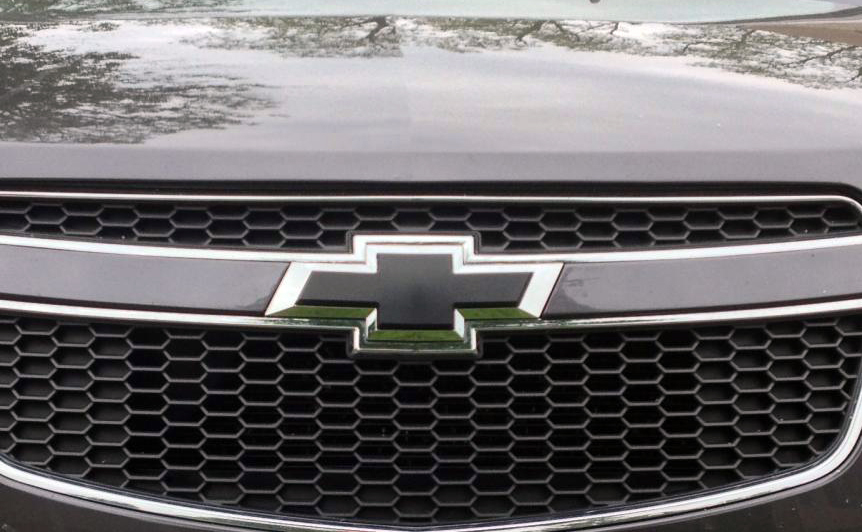
A few months ago I met a Chevrolet Sonic on the highway.  The owner had replaced the centerpiece of the iconic gold bow tie with a body colored insert; in this case, the bow tie is now orange.  Since that sighting I’ve mentally taken note of just how common it has become for Chevy buyers to customize their bow ties, leading me to believe Chevy should embrace this from a marketing perspective by letting the bow tie go freestyle.

Here in truck country I’ve specifically noticed dozens of Silverado’s with custom bow ties; most of them end up being black, however I’ve also seen red ones and even one camo bow tie.  In the case of most, the added custom touch actually looks pretty good, especially the black bow ties.  This trend also seems to be prevalent amongst Camaro owners, which is not terribly shocking considering the rate at which Camaro owners modify their vehicles.

Granted, my evidence here is anecdotal, however there are some macro-level trends in the market and amongst consumers that also support the idea of the brand embracing their owners’ idea.  Firstly, bow ties are making a comeback in men’s fashion.  As someone who dresses in business attire on a daily basis, I continually find a host of bow ties in stores, from black ones to ones with outright crazy patterns.  It is sort of a hipster trend that has trickled down to the mainstream, and one that Chevy could fall in line with on a subliminal level.

Secondly, the illustrious Generation Y (my generation).  Studies show Gen Y likes custom, unique attributes in products.  We are the generation of individualism, and what is more individualistic than a custom design for the front of your car?  Chevrolet is apparently already aware of Gen Y’s tastes for uniqueness, because they are already offering graphics packages and other custom pieces for their small cars, the Sonic and Spark.

Most importantly, the gold bow tie has a stigma attached to it.  In fact, I recall reading at some point that the gold bow tie does NOT clinic well with consumers, which would likely explain why I have noticed more and more Chevy owners covering the gold with the hue of their choice.  Gold is a stodgy color and from a visual perspective, it sort of clashes with some exterior colors, like bright red and orange.

There’s also the loyalty element to allowing owners to do this.  By customizing their Chevy, they’re making it a little more personal to them – special.  From an emotional level, it’s connecting the buyer to their product further, and if Chevy ran the customizing process…it would be another added touch-point between the brand and their customers.  Every OEM is making great vehicles today, it’s the OEM that can connect with buyers on a higher level that will ultimately gain buyer loyalty.  Baseball, apple pie, and Chevrolet….America is about individualism, so how fitting that Chevy do this?

As a marketing guy who obsesses over branding consistency, it’s ironic I’m suggesting this.  In the case of Chevrolet, it isn’t the gold color that is iconic to buyers, it is the bow tie shape itself.  In fact, Chevrolet itself has not consistently used gold as the centerpiece of their bow tie.  As recent as in the last decade the brand was still using blue on car models.  People are not identifying Chevrolet from gold, they are identifying the brand because of the logo shape.

I’m not saying the entire brand should re-brand.  For consistency purposes Chevrolet should absolutely maintain status quo on the corporate level with collateral and advertising.  I also think they should continue putting gold bow ties on their vehicles.  What I’m suggesting is offer buyers the option to have a cover plate for their bow tie, and let them have fun with it.

Once a Chevy owner buys a new product, they can go online and design their bow tie free of charge through Chevrolet’s “My BowTie” service.  It is then sent to the owner’s home and easy to attach to the bow tie found on their grille.  In the box with the custom bow tie could be an insert sheet encouraging them to Instagram a pic of their custom bow tie with the hashtag #mybowtie or something similar.  The sharing generation (Gen Y) would likely publish a photo of their art work on their social networks, that’s almost a given.  Then the owner gets a piece of their personality on their vehicle, and Chevy gets word of mouth online.

The “My BowTie” service could also sell additional custom prints for buyers that want to switch beyond the one free unit.  They could even offer high end units made out of real alloys or carbon fiber for the more discerning Chevy owner.

There’s likely a lot more that would have to go into this concept, but I have been thinking about it a lot lately.  Today alone I saw six different Chevy’s with custom bow ties on the front…the owners are doing it, might as well embrace it.

By the way, I’d want a greyscale camo bow tie on my black Camaro ZL1.

Tagged , , , ,

The Pitch

I often generalize business as the art of getting people to do what you want.  It’s probably an over-generalization of what is typically a complex operation, but really that’s what most of us in the business world do – work to get our (or our organization’s) way.  Working for a company that is undergoing a transformation, I spend a lot of time pitching ideas – to vendors, management, community leaders, or our board.  Throughout that time I’ve decided that there’s a distinct difference between perspective and opinion, and you should try to change only one.

When I start pitching an idea to someone, I always start out at a bird’s eye view of the project or idea, and sometimes even a tangent line away from the actual meat of the idea.  Everyone always has differing opinions and for me to come in and try to change an opinion that was obviously shaped by something other than thin air, just doesn’t make much sense.  Frankly, changing opinions is tough business and a relentless task – especially for the one who is usually the youngest in the room.

My theory is that opinions don’t matter in business.  What matters to me when I’m pitching something is their PERSPECTIVE.  Their perspective is what drew them to the opinions they have.  I try to start at the core level of the idea or even away from the idea and narrow it down – set the stage not only for the actual idea, but why the hell I got to that idea.  I sell my thought process, and assume the idea will sell itself (this also portrays confidence, which people subconsciously pick up).

Typically after I’ve laid the foundation as to why I have this idea in mind (what shaped my perspective on it) I try to get buy-in from the people in the room.  I’ve found people are usually more inclined to agree to broad based concepts rather than a narrow focused idea, for a variety reasons.  So if I can get some nods of agreement on high-level ideas, I go straight to the conclusion.

Instead of PowerPointing my way to the end, I typically jump from broad focus right to the “this is what will happen” part.  I do that because everything between the high level stuff and the end is really just a means to a conclusion.  I don’t want my audience to focus on the inside aspect of making the conclusion happen – that could make or break the deal.  The journey to the end is not always a pretty picture, what matters is that the conclusion is on par with corporate strategy.

I’ve often heard sales people use the personal selling tactic of “leading to a conclusion” – essentially guiding the client to the desired conclusion like they’re on a leash.  I disagree with that.  I’m there to bring a conclusion in the first place, and convincing the audience of my conclusion by reshaping their perspective on the idea is my strategy.

Throughout the last year I’ve had the pleasure of sitting through many pitches from vendors.  From buying air time flights to buying millions of dollars in IT equipment, I’ve been pitched at as much as I pitch.  Most of the time they immediately start out with the product/service benefits, and the conclusion is the price.  At no point do they give me a broad based concept to work with – it’s all detail.  When my organization is about to drop seven or eight figures in capital on something, it’s effecting more than just one function of the company, and the pitch should too.

We’re Going Gig

I’ve posted many times on here about my “day job” employer, Columbus Telephone Company.  As one of the few independent telecoms left the nation, we’ve been bucking the trend and pioneering technology for over 107 years now.  We had the first digital phone switch in 1986, were the first fiber-to-the-home provider in the state in 2005, and now we’re embarking on our next-generation network to bring our customer 1 Gbps ultra-broadband.

Most of you have probably heard about what Google Fiber is doing in the Kansas City market.  They had a national contest to select a city or region to roll-out the company’s first ever fiber-to-the-home operation.  Their operation did not start until 2012, however the headline that has come with it is the fact that they are already offering 1 Gbps Internet service, which is largely unheard of in the U.S.

Naturally, having a name like Google attached to their project has given them a vast amount of publicity, which I’d argue has paid off more for the Kansas City metro area than the actual fiber-to-the-home service.  KC now has Internet start-ups forming in dumpy neighborhoods – right in residential homes.  The proverbial “Silicon Prairie” is nothing new as Internet entrepreneurs seek out the low cost of living in the country’s mid-section and enjoy the (in many cases) much better broadband service than either coast can provide.  Kansas City, however, was not in on the action until Google trumpeted their horn and laid the foundation for ultra broadband, so we’re getting in on the action.

For us, we don’t need Google.  Back in 2003 when we announced our original fiber-to-the-home imitative, we were one of only a handful of companies nationwide embarking on a FTTH network, and we’re about 99% sure we were the only company in the nation to have a zero-copper network.  So by today’s standards, our eight year old network is better than what 99.8% of U.S. households currently have.  Unfortunately, that’s not good enough for us.

Today we formally announced our next-generation FTTH network.  For marketing purposes, we’re calling it Fiber 2.0.  Our new network is enabling us to offer the ultra broadband speeds that we feel are a necessity to keeping our area and customers ahead of the curve.  Once completed later this year, we’ll be able to offer the same 1 Gbps speeds that Google is trumpeting in KC, plus position us to continue expanding our broadband offerings for several years to come.

As the company’s marketing guy, I’m totally geeked to have the opportunity to tout our new services.  It is no stretch for us to say that, in a few months, you’ll be able to stack our company’s network up against any city in the world, and no shame will be felt on our end.  It truly is world-class, meaning it is a marketer’s dream.  I don’t have to spin this – it literally is the best and we have the brand and the plan to make everyone aware of that.

Our small company is proof of my theory in business: when passionate folks are running it, success comes naturally.  We don’t dwell on specific metrics of success.  We have a corporate strategy to provide the best product and best customer experience.  All decisions go back to that one metric and said decisions are made by people that really do care about the company.  There are no “silos” or disjointed “accounting has goal X, marketing has goal Y” mockery – we all rally around the same goal and I’m convinced more than every that is the key to our success.

From Forum to Pioneer

Undoubtedly the accomplishment I’m most proud of resides at the web URL www.GMInsideNews.com.  I first found that site back in 2003, while suffering boredom in my seventh grade English class and instantly became hooked by what it was.  GMI was different than the other car websites I frequented; it had different information and allowed people–including me–to talk on the site.  My 12 year old self was utterly amused at the prospects at the time.  Little did I know that the discovery of a website would reroute the course of my personal life and end up being a pillar in my professional life.

From that day in April 2003, I remained affixed to GMI, visiting the site at least a few times a week.  By June I had decided I was ready to take it to the next level and begged to become a moderator on the forum.  Clearly I have been mesmerized by authority since a young age (scary, I know), so getting a title and different colored username was enamoring to me at the time and served as high octane fuel for my motivation to help out on the site.

As time went on I became more involved on the site, eventually realizing that what we had with GMI was special.  GMI was more than a discussion forum and the whole team had this collective vision and dream for what it come eventually become.  This ended up really being the first time in my life that I rallied behind something because I truly believed in it.  The vision and the team that formed it were on a path for great things and I was convinced we were going to accomplish it come Hell or high water.

As the Fall of 2007 approached the site’s owner was forced to step away from the site, leaving a mild power vacuum in his demise.  Perhaps to the dismay of some of my colleagues at the time, I sort of just jumped into the captain’s seat and started running the site.  For me it wasn’t a power trip; I was so intent on carrying out the vision for the site that nothing else mattered at the time and the power vac was not about to suck the wind out of our sail.

A few months later the owner sold the site, with the new owners asking me to continue running the site as a contract employee.  At the time I was a 17 year old attempting to wrap up high school, so accepting (another) job was not high on my priority list.  However at the time we had made great strides in the “vision” and I kept thinking in my head, “With more resources we can finally make this work..”  After finding out that the purchaser of the site was ran by a guy who started the company at 16, I realized that at 17, I was if not anything…a bit late to the game.  I accepted.

When I took over the site it had virtually no positive relationship with the company it followed so closely (GM).  In fact, the only relation GM had with the site was negative; in the form of them shunning the site and the former owner adding fuel to their fire.  The entire situation was a case of a large corporation not knowing how to handle “new media” and site management that was convinced they did not have to have a relationship with the company to thrive.

I was not convinced the hate-hate relationship between the site and GM was conducive for either organization.  By fall 2009 most of GM communications had turned over to personnel that were open to new media, so I began driving them nuts with inquiries and olive branches to work together.  After some backdoor correspondence with the c-suite (hey, we are GMinsidenews), our request for discussion was granted.  So at 19 I had a conference call with 4-5 director level employees of a Fortune 20 firm about starting over the relationship they had with GMI.  And from that point on, it’s grown into a relationship with uncharted waters.

As time has progressed, the relationship between GM and GMI has become pioneering.  The entire relationship started out with GM extending some of the perks of being a media outlet, but has since evolved to be far more meaningful than just that.

Today GMI has a solid relationship with it’s following company in three countries, spanning two continents.  Arguably the most conductive relationship has been between GMI’s Australian staff members and GM Holden.  The relationship has brought GMI’s global audience some of the most extensive coverage of Holden in the industry.  In fact, no mainstream automotive media outlet in the U.S. has staff on the ground in Australia, yet GMI does and Holden allows them to cover the company like local media.  This combination has brought U.S. readers interested in Holden (of which there are many on GMI) unmatched coverage during Holden’s most interesting periods.  Holden also participates on the forum periodically.

Here in North America the relationship is much the same, just on a bigger scale.  While we’re treated like mainstream automotive media now, we’ve also notched out further intricacies with GM in North America.  For example, the president of GM North America (Mark Reuss) personally participates on the forum; even interacting with users and answering their questions.  In fact, Reuss will tell you he’s on the site regularly and can even recall a few usernames that, um, standout for their candid feedback.   Much to my surprise, our readers really treat him just as any other member…which is really the beauty of the site.

After nine years on the site, I think the vision the team and I had for it was finally carried out.  Our readers are well educated on the subject we cover, we still break a boatload of inside information (sorry, GM) and now our “formal” relationship with the company is right where it should be.  Today the site has entered into the status of “how can we advance from here?”  Organically expanding the scope and breadth of the site will never be finished, only optimized and evolved.

I certainly cannot take all of the credit for the relationship that’s been chiseled out with the site.  Without the global team and expanding audience of GMI, it never would have happened.  GM deserves a large amount of credit as well for allowing our relationship to get to this point.  As an OEM they have really been the first (to my knowledge) to let an enthusiast site get this close.  I have often heard the saying, “Your best customers are on forums” – without a doubt true in automotive, and it appears GM has been the first OEM to fully realize and appreciate this.

For the record, my honesty for calling a spade a spade is well documented.  GM legitimately deserves a lot of credit for what’s been accomplished here or I would clearly say otherwise 🙂

Buick’s Marketing Miss With Regal GS

My black Regal GS tester near an old downtown building in Joplin, Mo.

Ed. Note: This will be one of few automotive posts on here.  It is very rant in nature…what can I say, I’m passionate about some stuff.

In case you haven’t figured it out by now, GM’s Buick brand has been on a rebound in recent years.  Ever since the launch of the successful Enclave in 2007, the brand has fairly consistently had one good product after another.  One such product has been the Regal GS sedan, a niche sport sedan that is–if nothing else–successful at giving all preconceived notions of Buick as an old-people brand the middle finger. Despite the fact that the GS screams anti-Buick stigma, the brand has thus far failed at capitalizing on it, particularly with Gen Y.

Let me start by saying I am not here to debate the Regal GS in terms of mechanical status or technical merit – I have another website for that.  This entire post is about the image and marketing of the car.

Based on Opel Insignia OPC (ascetically, anyway), the Regal GS sports vertical “fangs” on the front clip, integrated dual exhaust out back and absolutely gorgeous forged 20-inch polished wheels.  To top the car’s image off, the first impression is formed around a shocking growl from the exhaust and brakes that say “Brembo” on them.  Collectively, Buick isn’t the first auto marquee one thinks of when the car drives up. Oh, did I mention it also has a six-speed manual?

Granted, the GS has been hotly debated because of its turbo four-cylinder power and front-wheel drive configuration, but for image purposes…no one cares outside of car junkies like myself.  The indisputable fact is that this car’s image is defying brand perceptions at the highest possible levels.

I’ve been fortunate enough to have two Regal GS testers in the last six months.  The first was a black-on-black manual tester, and the one I have right now is a stunning red automatic version.  During my stint with both cars, head’s have constantly been caught turning to see what just drove by and bystanders asking questions is just the norm with it.

Once I tell them that it’s a “BUICK Regal” my reply is typically met with this puzzled, WTF? face.  For the select few that I’ve granted rides in my GS testers, the look usually ends up turning into a grin…particularly when the H/K sound system is deemed bump-worthy and the flat-bottom steering wheel is acknowledged.  It should be noted that my testers are typically driven around a college campus, not a retirement home.

Then the other day I was standing in the university parking lot.  As always I was scanning the vehicles to see if there was anything remotely exciting (yellow Aveo’s and Grand Am’s only go so far), and to my surprise this time there was!  Resting in one of the parking slots was a black, loaded Regal GS.  In the STUDENT parking lot.  I was absolutely stunned.

As fate would have it, the next day I figured out that the owner of said GS actually sat next to me in one of my classes.  She (yes, a female) was a 21 year old college student driving a brand new Buick.

As often the case, the revolution of this caused my analytical mind to go into overdrive.  Then, the following week (this week) I get my second GS tester and gauge overwhelmingly positive responses to it from my peers.  The combination led me to this…

Thus far Buick has failed to capitalize on the Regal GS’s image defying ability.  Yes, they advertise the car as a sports sedan, but the commercial with a middle aged couple fetching groceries (while good), is not doing the car justice.

Buick must start putting this car in front of Gen Y.  I realize that my generation, as a whole, does not have the purchasing parity to support the Regal GS, but that isn’t the point.  Buick lost a generation of buyers (my parents).  The brand has a chance thanks to my generation’s open mindedness to brand names, but we must be influenced early.  The GS in front of 20-30 year olds is the perfect way to pave a long-term path to success for the brand with Gen Y.

Once my generation is graduated from college and achieves their first “real” job, they are going to want to reward themselves.  In many cases, that’s going to be a premium car.  They likely won’t be able to afford the cool Cadillac’s, but they probably could manage a $36,000 Regal GS.  Most of Gen Y has watched our parent’s generation struggle and now we have struggled through the 2007-today economic conditions…Gen Y will be more than ready to reward themselves once the time is right to do so.

Need I also mention Gen Y’s influence on our parents.  As someone who witnessed the Facebook revolution while working for an ISP, I saw first-hand how grandparents and parents were adopting Facebook in droves…because the grandkids/kids were on there.  When Gen Y finds it “cool” the older generations seem to be following suit.  If Gen Y start’s positive word-of-mouth about Buick, perhaps the “lost generation” will warm back up to the brand.

What’s more interesting is that almost every GM brand has–at some point–tried to leverage an unprofitable “niche” product to use for image improvement.  We saw it with the Pontiac Solstice, Chevrolet SSR, Saturn Sky…the list goes on.  In almost every case the image improvement was never meaningful enough to justify the insanely unprofitable product.  Ironically, the GS is (I assume) profitable and is a better image changer for Buick just because, on the bandwidth of old vs. new Buick…the GS is beyond the scale.  The car literally squashes every bad perception of the brand.  On the other hand, the Solstice still had a crappy interior like all Pontiacs and the SSR was just useless.

Despite my antics, Buick does deserve some credit.  The brand has lowered its average buyer age and almost half of its sales are to non-GM owners; both excellent numbers and no small feat.  In fact my main hang up is really about the GS in particular because they keep using that same timid marketing that the rest of the brand gets.  The “your kind of luxury” branding is nice, but it does not appeal to me or likely anyone else in my generation.  Unfortunately I fear Cadillac is likely to blame for this…they don’t want Buick stepping on their “edgy” image.  To Cadillac I say this…move up-market where you belong.

NOTE: Part II of this will include my ideas of changing the GS marketing.